Indiana
Missing YouIndiana is both the home state Jessica Mastriani once left and the place where a possible future begins to take shape. The state first made her famous as “Lightning Girl,” but its significance changes when she returns: its midsummer green, familiar relationships, and the prospect of teaching make home more than a point of origin. By the end, Indiana is where she decides to transfer and pursue a teaching certificate.
Home State and Public Identity
Jessica identifies Indiana as the place she is from, and it is there that the news of her lightning strike and dream-based ability to find missing people became a major public story. The attention was especially pronounced in Indiana, where a cable television show was made about her life. Its version departed from reality: it invented FBI training at Quantico and killed off her father, who was alive. The show’s distortions underline the gap between Indiana’s real Jessica and the simplified character made from her story, even as the state remains the setting associated with her unusual ability and public reputation.
The television rights also gave Jessica a continuing financial connection to the story that made her known. Her parents invested the monthly checks, leaving the principal untouched; she spent some of the interest when she needed money for food or rent. She had a summer job as well. This detail places her Indiana identity alongside a life that is not defined solely by the spectacle of her powers: the famous story produces income, but her ordinary needs and work continue beyond it.
Return and the Landscape
Jessica returns from New York City on a short flight to Indianapolis, sharing the cramped plane with Rob Wilkins. At the airport, Rob has his Indian motorcycle waiting. He offers to rent a car when he sees her reaction, but she accepts the spare helmet and rides behind him. The motorcycle recalls their earlier closeness, though Jessica is careful not to settle on a name for what they had been. Her return to Indiana is therefore also a return to a relationship whose meaning remains unresolved.
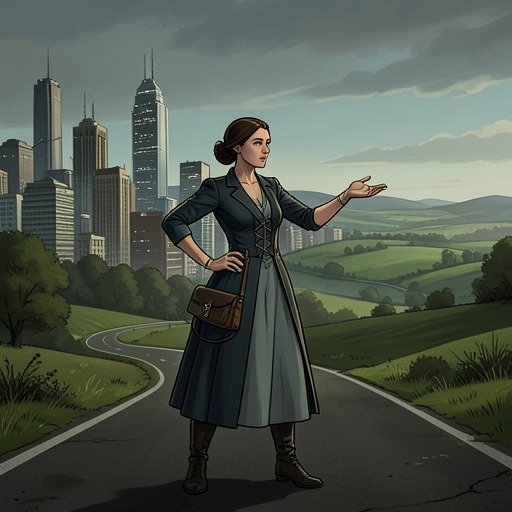
The state’s landscape registers as a physical contrast to the city she has left. When Jessica was last in Indiana, over spring break, buds were only beginning to appear; now they have opened into midsummer growth. She sees green everywhere, extending toward a cloudless blue sky. New York has trees along many streets, but its overall color, in her account, is the gray of sidewalks, streets, and buildings. The contrast is not simply rural scenery against urban streets: the sudden abundance of green makes Jessica recognize how much she has missed Indiana. The landscape gives her return an emotional force before she has decided what she will do there.
Small-Town Connections
Indiana appears through more than Jessica’s own homecoming. At a confrontation involving Randall Whitehead Sr., she identifies Kristin Pine as a fifteen-year-old from Brazil, Indiana, and tells her that her parents had been worried and that her father was relieved to hear from her. The exchange makes the state a network of family connections extending beyond Jessica’s immediate circle. Brazil is not an abstract point on a map here: it locates the parents who want Kristin to return and gives her disappearance a specific homeward possibility.
Other details suggest a community life organized around nearby towns and familiar local destinations. Douglas Mastriani recommends a place near a river outside Storey, Indiana, describing it as worth the drive and romantic. Jessica redirects the plan toward picking up burgers instead. The brief exchange gives Indiana a scale of travel and sociability: a nearby town, a river-side destination, and people who know one another’s routines. It also shows Douglas trying to create an opening for Jessica and Rob, while Jessica resists the implication before the invitation can develop.
A Possible Future
The return gradually becomes linked to work and education. Douglas imagines an alternative high school that parents and students could both love, a school the community could take pride in. Tasha Thompkins makes the invitation personal by suggesting Jessica might want to come back and teach there. Jessica is astonished at the prospect. Douglas points to her summer work with Ruth as evidence that teaching is not an implausible direction, but at first Jessica is unsure whether she can stay in the same town as Rob without being with him.
That hesitation makes Indiana a place Jessica must choose, not simply a place she can miss. In a call with Ruth, she admits she does not know whether she will come home, and she has not yet mentioned Douglas’s teaching offer. Her uncertainty joins the professional possibility to the emotional complication of Rob’s presence. The question is no longer only whether Indiana feels like home; it is whether she can shape a life there while confronting what she wants from that relationship.
Jessica ultimately tells a visitor that she will transfer to Indiana and obtain her teaching certificate. The decision gives the state a new significance: it is not merely where her powers and fame began, or a landscape she recognizes with longing, but the setting of a chosen career and a return to community life. Indiana’s role in her story shifts from origin to destination, while the teaching plan offers a way for her abilities with children and her future work to matter without making her psychic power the sole basis of her identity.